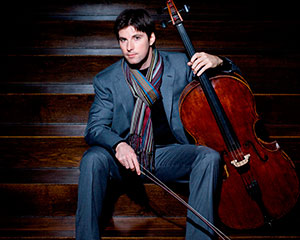
 Left – Daniel Muller-Schott. Photo – Christine Schneider
ACO2 is the orchestra junior, I s'pose you might say, to the Australian Chamber Orchestra proper. That Tognetti and co should've come up with such a fiendishly clever double entendre says much about the outcome. Even the most discriminating audience, if blindfolded, or even if not, would be challenged, to say the least, to find any chink in the armour of excellence that so consummately characterises ACO ventures. ACO2 is breathing pure musical oxygen. As such, despite the fact of the matter, in a way it's basis and backstory does it injustice: it's a very legit orchestra in its own right, very capable of standing on its own two feet (or thirty or so) and mix it with the best of 'em: no caveats, qualifications, ifs, buts, or maybes. If you're looking for the finest young string players in this country and, most probably, well beyond, this is where you'll find them. The best of the best typically secure positions with major Australian and international orchestras, if not the ACO itself, as in the case of Madeleine Boud and Rebecca Chan.
This was one of the Sydney engagements on the fourth tour by this chamber outfit, that's largely a product of the ACO's education initiative, born of Tognetti's vision, in 2005. The ACO's principal violinist, Helena Rathbone, has been directing it since inception, as part of the Emerging Artists Program, which affords high-achieving tertiary students direct access-all-areas pass, more or less, to the orchestra, by way of rehearsals and up-close-and-personal engagement with players, taking the form of mentorship, one-on-one lessons and performance; even guesting with the orchestra. It's about the most generous and meaningful of baton-passing gestures, in the entire orchestral milieu, as far as I know. That it should end up performing as part of the ACO's touring subscription series is testament to Rathbone's success: the main orchestra clearly subscribes to the belief ACO2 is ready for the fullest public scrutiny.
A further exemplification of confidence is Tognetti's decision to personally front the tour. He certainly gave an engaging and playful introduction to the concert, even if his microphone technique left a little to be desired. Good thing he isn't a singer.
As is typical of the main orchestra also, the program for this Concert Hall performance couldn't really have been more diverse, intriguing or captivating, beginning with Einojuhani Rautavaara's (try saying it three times, quickly) The Fiddlers, composed in 1952. After Sibelius, Rautavaara, of course, is the Finnish composer. Even Sibelius thought so. Interestingly, The Fiddlers was born as piano music and wasn't arranged for strings until it turned twenty. The five movements were based on folk dances by an eighteenth-century countryman and this endows a narrative thread. This was a comparatively down-to-earth basis for a composer very much influenced by metaphysics and religion. But Rautavaara's adaptations remind me of Darryl Kerrigan (Michael Caton, in The Castle), consistently complementing his wife on her cooking: 'it's what you do with it!' His 'free fantasies' are, in a way, the classical equivalent of jazz improvisation and, given the creativity he displays, one can't help but wonder what strides he might've made in that realm. Later in his career, by about the time this suite was set for strings, he did enter that fray. The early attachment to folk melodies is something he shares with Bartok (also in this program), but his corpus is rooted in modernism.
Narbolaisten Braa Speli (The Narbo Villagers In Fine Fettle), the first movement, will knock your socks off. To many ears, it will sound shockingly dissonant; humourously so. It's stouthearted to harmonise the tunes in this way and ACO2 doesn't shrink from communicating Rautavaara's boldness, with a lusty delivery, making the most of this processional with broad bowing, realising the movement's orotundity. We can well imagine the self-heralding arrival of these rustic fiddlers, who can't quite agree on the unison note, in the township. The marriage of Arcadian ingenuousness and classical sophistication is both surprising and charming.
Kopsin Jonas is written about a particular fiddler, more reclusive than the hard-partying ones arriving in Narbo. As he plays, alone, in the forest, with but trees for an audience, there's a sense of menace and the darkly ominous, provoked by an insistent violin and booming bass notes. But there's also a sense of serenity (speaking of Darryl Kerrigan), redemption and peace. The contrariety is superbly balanced and when the pastoral theme arises, it's ravishing, like a fleeting glimpse of love in a life's wheel of pain. Broody, but beautiful.
As the name implies (Klockar Samuel Dikstrom), Sam is a bell-ringer, but he's also the church organist and we hear him toying with wedding songs when he should be practising his Bach. It's playful, subtle (albeit in the most robust possible way) and its sectional call-and-response motif delicately dealt. With hints at the dissonance invoked earlier in the suite reiterated, it's a seamlessly integrated movement. There's something very cinematic about it too and I begin to wonder, has it ever been used for a film? There are even Mozartian and Vivaldian infiltrations herein, it seems to me.
Pirun Polska translates, roughly speaking, as devil's dance. Curiously, it has a Hungarian aural aesthetic (though perhaps that's because the devil is almost certainly Hungarian), most pronounced and loudly proclaimed by phrases played on Tognetti's violin which, all of a sudden, becomes The cellos and bass that introduce and conclude the movement were bowed sublimely, with profound feeling. In effect, the devil sounds a bit down in the dumps. Hanging out in the Finnish forest doesn't seem to do much for his disposition.
The jaunty final movement, sounds like a cogent argument for the rabbit-proof fence, with strings hopping all over the place. (Little wonder it's called Hypyt, which means jumps.) The fiddlers apparently whirl like clumsy dervishes, to conclude this musical equivalent of a Grimm tale; strange, but wonderful and a very intense experience, given just seven or so minutes duration in all.
It's a big jump, or so it seems at first, from Rautavaara to Vivaldi's double cello concerto (though Rautavaara, too, has penned cello concertos), but if any orchestra can make such quantum leaps it's the ACO and its little brother seems just as fit. Vivaldi predates Rautavaara by two-hundred-and-fifty-years, so you'd expect some distance, in all senses, between them. One was baroque; the other, a modernist. The so-called red priest was, of course, a great friend of egocentric violinists everywhere, since he probably did more for gifted exponents of that instrument than any other composer. He did similar favours for cellists, inasmuch as he also holds the high-score for cello concertos (twenty-eight, if I'm not mistaken). In fact, he practically invented them: his first two concertos per se, as far as we know, were for cello. We're talking very early eighteenth century. It's quite a sombre, almost dour work (albeit with Vivaldi's incomparably light touch), given the minor key involved (G) and the pairing of cellos, which can sound like two sad beagles pining for their master. Apart from anything else, it's a marvellous showcase for guest soloist, Daniel Muller-Schott, as well as our very own Finnish-Australian principal cellist, affectionately known as Tipi; Timo-Veikko Valve. There are certainly Vivaldi trademark motifs: cascades and flourishes and ornaments aplenty; Vivaldi is to concerti as Venetian is to glass.
Just as Rautavaara's fantasias embodied improvisation, so too Vivaldi's adaptation of the concerto form afforded much individuality and the sensibilities of the aforementioned cellists ensure both really step up to the plate with highly-individuated colourings. It's quite astonishing their instruments sound. Or perhaps not. It's all Italian to me, but Muller-Schott bows the very same violoncello formerly played by Harvey Shapiro, handcrafted by the renowned luthier, Matteo Goffriller. I imagine, were Vivaldi around to witness it, he'd find its tone agreeable, since it was made in Venice, in 1727. Though built only two years later, Tipi's Guarneri sounds quite distinct, just as one can imbibe two great varietal wines which taste nothing alike. In the very first bars of the opening allegro, Vivaldi seems to find a point of resonance between the two cellos at which one's very soul vibrates. Then, in surge the other strings, like Freo doctor. Muller-Schott and Tipi demonstrate profound empathy and superb control in the subsequent largo. Achingly beautiful is now a cliched phrase, but I'm struggling to think of another, more apt one.
One can scarcely imagine the twentieth century without Stravinsky. The Basel Concerto (in D major) is a staple for string ensembles and Igor himself, by all reports, seemed to approach its making as if he hoped it would be his apotheosis. As with many of the other works in this program, this work has nothing if not concision. And, thanks to the discipline and dedication of ACO2, precision. Musicians and academics may deliberate over whether it's more divertimento (a diverting form of light eighteenth-century chamber music) or concerto grosso (an earlier baroque style that has a selection of soloists vie with the full orchestra), but Stravinsky confounds us, and them, by interpolating elements of both. The first movement, Vivace, is very stop-start conversational: there are fits of effusion; pizzicato is counterpointed with tentative lyrical phrases; dissonance and consonance torment each other; all-in-all, an exemplary exploration of rhythm and texture. I imagine it's exceptionally challenging for an orchestra, large or small, to juggle all these demands, but ACO2 plays second fiddle to none, or my ears deceive me.
As with Rautavaara's fiddlers, this work is exceptionally picturesque and theatrical; little wonder it's been used, repeatedly, as a ballet setting, probably most famously by Jerome Robbins' New York City Ballet, in 1951, for The Cage. Throughout, it's as if Stravinsky is grappling with his own competing impulses: on the one hand, there's an almost relentless anxiety embodied in the strident ostinato, which ACO2 renders in unbridled and intensely dramatic fashion. It's relieved, at times (not least in the second movement, which opens with a pleasing, pastoral promise, even if it is 'threatened' by the low strings), but, by-and-large, IS would prefer we remained on tenterhooks. It's a work of impeccable craftsmanship (here, in the playing, too) and draughtsmanship. A quote from the eminent drama critic, George Jean Nathan, seism apt. 'Great art is as irrational as great music. It is mad with its own loveliness'.
Vivaldi made a welcome return to round out the first part of the program, with his Cello Concerto in G major (RV413). It really is a delectable sandwich: two wholesome, substantial allegros with a largo between. The opening allegro bursts forth like a teenager in love; all blushing cheeks and blue skies. It has Vivaldi's trademark élan; soaring, indulgent, yet never cloying; as light and airy as nanna's sponge, or nonna's zabaione, perhaps. You might think the violins would have had an unfair advantage, what with Tognetti, Rathbone and Aiko Goto leading the five up-and-comers in that section, but the cellos (Michael Dahlenburg and Anna Pokorny included), for example, sounded as taut and tonally rich as the violins bright. Again, Muller-Schott showed both his lack of egocentricity in the way he worked with the ensemble, while distinguishing himself as a player of individual style, who tends to adopt whatever music he's playing as his own. It's almost as if he's written it. The bassline is particularly jungly, but Josef Bisits took it easily in his stride. The largo begins in a more stately and sober, but soon brightens, like the sun emerging from behind a cloud. It's tempo seems deceptively lively given the directive attached to the score and there are delicate parries and ripostes between ensemble and soloist. ACO2 shows precisely how much finely it can play. The concluding allegro is buoyant, bobbing along like a cork on a current and, again, Muller-Schott shows his depth of empathy for both composer, the selection and fellow players.
George Frideric Handel would have to be in the top three bracket of baroque composers and his Concerto Grosso in A, Opus 6, No. 11, with its five elegantly compact movements is as good an advertisement as any for Handel's productivity. It took him little more than a couple of days, if that, to knock out what's agreed to be one of his greatest works. Forget state of origin. Grosso means several soloists, rather than just one, play cat-and-mouse with tutti. Among them, here, was Tognetti, who eked some sublime, yet characterful notes from his shark-bitten Carrodus which, happily, sounds to be suffering nary a symptom of PTSD. The violas (led by Christopher Moore), often left in the shadow of more arbitrarily glamourous strings, too, provided an especially warm middle voice, while Tipi's lower register reflected much of the inherent regality of the work
In design, Handel was, unquestionably, influenced by his Italian contemporaries (Corelli and Geminiani, for two), but also the French form of overture, as well as hints of Muffat and Scarlatti, apparently. Probably more than all those, however, he was influenced, in all humility, by himself: specifically, his organ concerto in the same key. Just as Rautavaara adapted his piano score for strings, Handel skilfully redrafted his hot-off-the-press (actually, not quite, as it hadn't yet been published) keyboard work, ending up with what have come to be acclaimed as two masterpieces, for the price of one.
In terms of emotional impact and, largely, thanks to Muller-Schott, it was, perhaps, Bloch's From Jewish Life which plumbed the depths. Film music is something to which purists may be averse, or of which they may be sceptical and suspicious but, in observing that Bloch's 'triptych' (essentially, a concerto) could viably be, say, the soundtrack to Schindler's List, or something similar, is not to demean it. On the contrary. It's to suggest its propensity to be moving; to prime and cue one's susceptibility to experiencing sadness, by way of a tuneful aural milieu. The secret, technically, is something comparable to what's described as a blue note, in jazz; a trait common to Yiddish musical expression. It's the bending of notes, in the subtle measure of a quarter-tone, that makes all the difference. M-S pays profound homage to Bloch's heartfelt compositional sensitivity: his rendition isn't about promoting his obvious virtuosity, but paying the utmost respect to the intention of the pieces. The orchestra's harmonies lent supple support and colour. The relationship between soloist and ensemble was practically unsurpassable, even by the standards of the mothership. This, for mine, is what sets the ACO, philosophically and in practice, apart. Not only does it strive for technical peerlessness and unassailability, but fearlessness and irreproachability, in its determination to 'inspire and challenge'.
Finally, Bartok. His Divertimento. While Bloch made no claim to musical archeology, Bartok was candid about the infiltration of folk music in his works. It's all (though not just) about roburt rhythm and ACO2 seemed to be emphatic about this dimension. Bartok comes as something of a shock, after Bloch. He requires more complicity, or at least complicity on a different plane. The structure emulates the concerto gross, inasmuch as a concertino (consortium of soloist) is set against the ripieno (full orchestra). The mission? To vary the texture; create contrast; enhance dynamics.
The first movement, Allegro Non Troppo, is in waltz time, but this simplicity is confounded by what seems to be a deliberately ambiguous placement of beats and accents; syncopation is clearly evident and it, along with scalar idiosyncrasies, does much to influence what might otherwise be construed as mere deference to baroque respectability. Bartok, allegedly an unrelentingly intense man, kept things interesting by subverting expectations and leading listeners up and down garden paths until such time as they didn't know where they were.
The second, Molto Adagio movement is palpably, if not dramatically (though deceptively) successful in imbuing a sense of anxiety and dark expectation. Bartok plays with form, while toying, also, with our emotions. What a cad. The high voices almost sear, at times, like cold switchblades suddenly brought in close contact with one's throat, while the middle and lower sections sustain long shadows, as in noir cinema. ACO2 suddenly takes on a cloak of torment, needling us with not so blunt instruments. In a moderately masochistic sense, it's a delicious torture. Dissonance and latent atonality are Bartok's tools.
An Allegro Assai completes the set. A fevered rondo, there's a pervasive gypsy-inflected harmonic quality that also goes to other folk derivatives. Tognetti indulges us with a splendid cadenza and we're narrowly saved from a fate, intimated in the preceding movement, ending in tears. Bartok, as ever, presents a clear, uncompromising trial for orchestra and audience alike. The latter passed with flying colours. The former wasn't quite so easy to read. The paradox of Bartok is his fastidious notation mysteriously and inexplicably gives rise to a completely anachronistic sense of spontaneity. Go figure.
Just when you thought it wasn't safe to go back into the water, given what happened to Tognetti's precious instrumental appendage and the ominous throbs of Bartok, we were regaled with the unexpected pleasures of Haydn's first cello concerto. It flows as voluptuously as a velvet gown and Muller-Schott yet again impresses memorably with his embrace of Haydn's sustained notes and penchant for revolving moods around a single motif.
There's one string instrument ACO2 doesn't play. Second fiddle.
Richard Tognetti presents
ACO2
Director Richard Tognetti
Tour Dates: 13 – 26 June, 2013
Visit: www.aco.com.au
Newcastle City Hall: Thursday 13 June, 7.30pm. ticketek.com.au, 4929 1977
Canberra – Llewellyn Hall, ANU: Saturday 15 June, 8pm. ticketek.com.au, 1300 795 012
Sydney Opera House, Concert Hall: Sunday 16 June, 2pm. sydneyoperahouse.com, 02 9570 7777
Brisbane – QPAC Concert Hall: Monday 17 June, 8pm. qtix.com.au, 136 246
Adelaide Town Hall: Tuesday 18 June, 8pm. bass.net.au, 131 246
Sydney – City Recital Hall, Angel Place: Friday 21 June, 1.30pm; Saturday 22 June, 7pm; Tuesday 25 June, 8pm; Wednesday 26 June, 7pm. cityrecitalhall.com, 02 8256 2222
Melbourne – Hamer Hall: Sunday 23 June, 2.30pm; Monday 24 June, 8pm. artscentremelbourne.com.au, 1300 182 183